

- Blog
- 09. November 2026
Oszillator-Holdover-Leistungsstudie
Inhalte, die Ihnen auch gefallen könnten
by Dave Cocks, IQD Chief Engineer, and Nick Amey MIET, IQD Technical Director. October 2026.
A Study of Holdover Performance Versus the Quality of the Disciplining Signal
Receiver noise and timing holdover: a comparative laboratory study
Executive summary
A disciplined oven-controlled crystal oscillator (DOCXO) relies on an external reference while locked. When that reference is lost, the oscillator becomes the local source of time. IQD Frequency Products conducted a laboratory study to examine how the noise of different GNSS receiver 1PPS outputs related to the subsequent holdover performance of the same DOCXO.
Three receiver types were compared: a high-cost rack-mounted GNSS reference, a mid-range PCB-mountable GNSS receiver designed for timing, and a low-cost PCB-mountable GPS-only receiver not designed specifically for timing. In this test configuration, lower measured receiver noise was associated with better 24-hour holdover. All three configurations met the DOCXO's stated holdover specification of less than 1.5 µs over 24 hours.
Background
In a timing system, holdover is the period during which a local clock maintains time after its external reference has become unavailable. A DOCXO can use a reference signal during normal operation to discipline its internal oscillator and compensate for effects including ageing and environmental changes. The quality of the disciplining signal may therefore be relevant to performance after the reference is removed.
This study focused on the relationship between receiver output noise and the holdover performance achieved by one DOCXO under a controlled test procedure. It was intended to quantify the importance of reference quality and low-noise synchronisation in timing networks.
Equipment and methodology
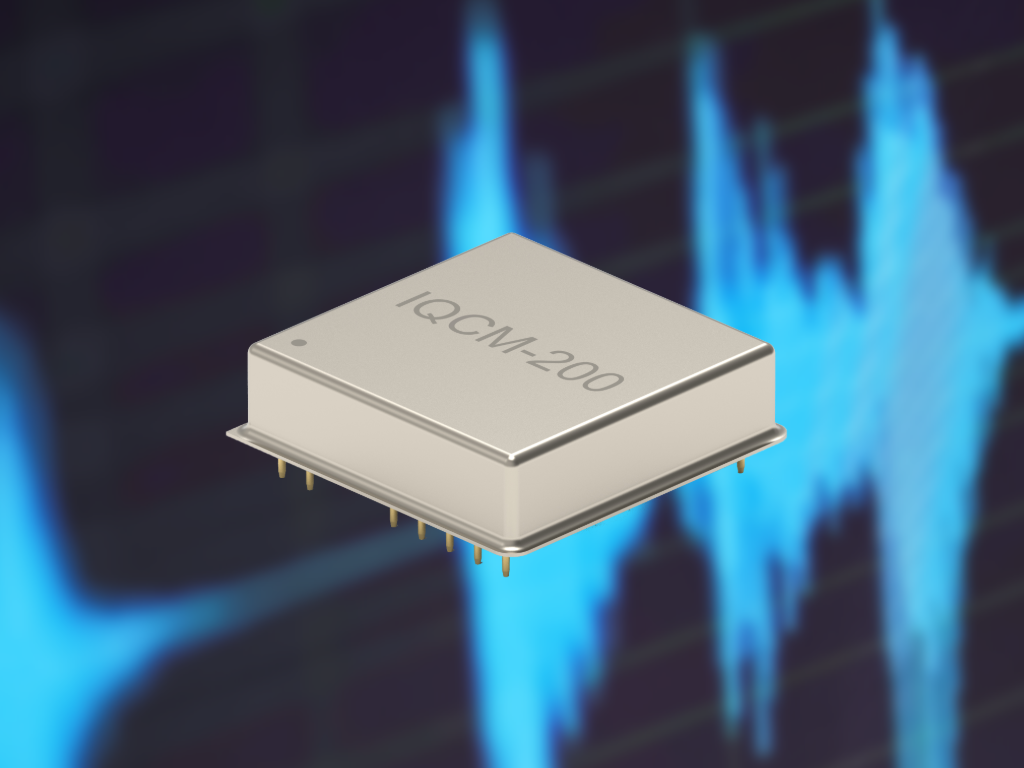
The device under test was the IQD IQCM-200, a DOCXO designed to provide less than 1.5 µs holdover over 24 hours. It accepts an input 1PPS signal, disciplines an internal 10 MHz OCXO and generates an output 1PPS signal. On loss of the input reference, it automatically switches to holdover and continues producing an output.
The same DOCXO was tested with each of three receiver outputs:
- High-cost: rack-mounted GNSS 1PPS reference, approximately £15,000.
- Mid-range: PCB-mountable GNSS receiver designed for timing applications, approximately £350.
- Low-cost: PCB-mountable GPS-only receiver not designed for timing applications, approximately £40.
For each receiver, the DOCXO was power-cycled with a five-minute off period, connected to the receiver's 1PPS output and disciplined for seven days. The reference was then disconnected, and the DOCXO output was measured for 24 hours using a Time Tagger X. The procedure was repeated three times for each receiver. With the further two times using a disciplining time of three days between each measurement.
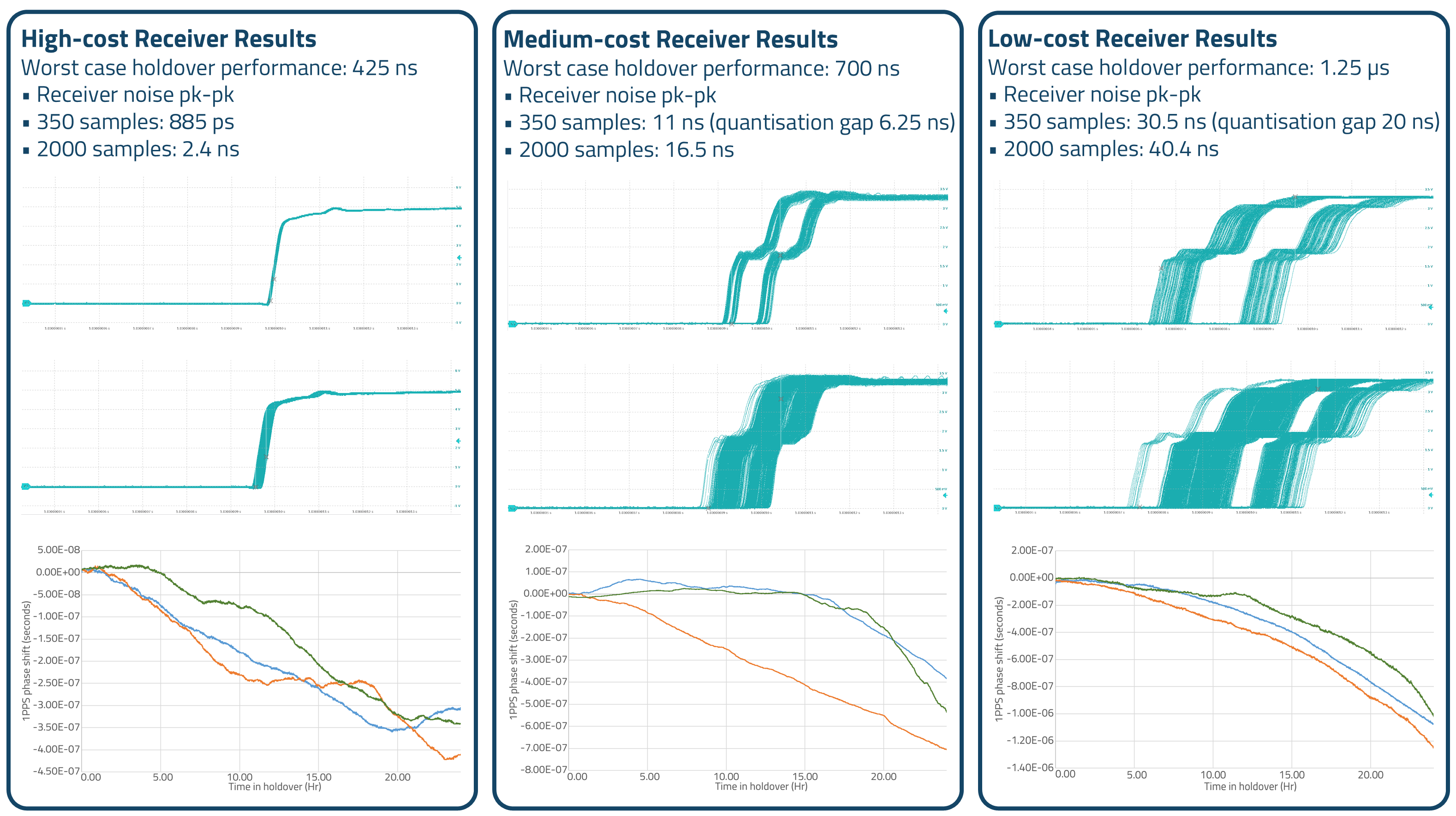
Receiver 1PPS jitter was measured using an MSO64B oscilloscope with 2.4 GHz bandwidth and 25 GS/s sampling. Peak-to-peak noise was recorded at 350 and 2,000 samples.
Results
| Receiver class | Approx. cost | 1PPS noise, 350 samples | 1PPS noise, 2,000 samples | Worst-case 24-hour holdover |
|---|---|---|---|---|
| High-cost GNSS | £15,000 | 885 ps | 2.4 ns | 425 ns |
| Timing-focused GNSS | £350 | 11 ns | 16.5 ns | 700 ns |
| Low-cost GPS-only | £40 | 30.5 ns | 40.4 ns | 1.25 µs |
The reported worst-case holdover values increased across the three configurations as the measured receiver noise increased. The high-cost receiver configuration achieved 425 ns, compared with 700 ns for the timing-focused receiver and 1.25 µs for the GPS-only receiver. Each result remained within the DOCXO's stated 1.5 µs, 24-hour holdover requirement.
Interpretation
Within the tested setup, the results indicate an association between lower 1PPS receiver noise and improved DOCXO holdover performance. This is relevant to system design because a reference used during locked operation may influence the local clock's behaviour after reference loss.
The findings should be interpreted within the limits of the experiment. The comparison used one DOCXO model, three receiver types and the stated measurement procedure. The results do not establish that receiver noise is the only factor affecting holdover, nor do they demonstrate that every receiver in a given price or product category will produce the same outcome. The poster reports three repeated runs per receiver but does not provide run-by-run data or statistical uncertainty.
Conclusion
All three receiver/DOCXO configurations met the stated 24-hour holdover requirement. In this laboratory comparison, the configuration with the lowest measured 1PPS noise also produced the lowest worst-case holdover error. For engineers designing timing and synchronisation systems, the study supports assessing the disciplining reference and the local oscillator as parts of the same timing chain - particularly where continued timing performance during reference interruption is important.
Study source: IQD Frequency Products, “A Study of Holdover Performance Versus the Quality of the Disciplining Signal,” presented by Dave Cocks, Chief Engineer, and Nick Amey MIET, Technical Director. October 2026.